
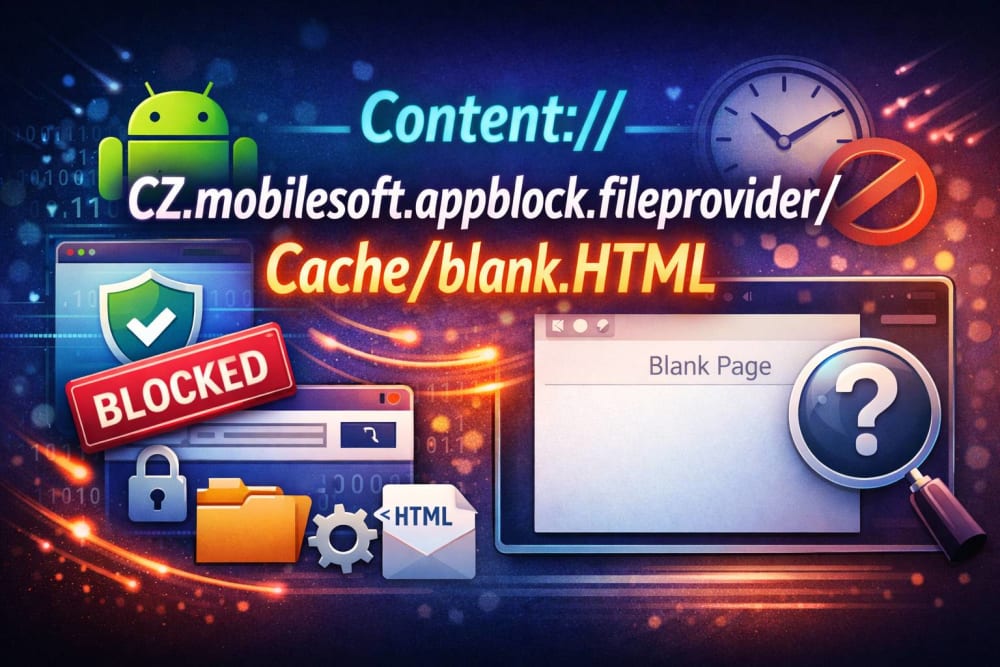
The string Content://CZ.mobilesoft.appblock.fileprovider/Cache/blank.HTML often looks confusing, especially because it resembles a broken web link. In reality, it is not a public webpage but an internal Android content path created by the app AppBlock. It usually appears when a website or app action has been intentionally blocked and replaced with a blank placeholder.
Understanding this behavior is important before assuming something is wrong with your device. Many users mistake it for malware or a browser error, when it is actually a controlled response generated by a productivity or restriction tool. Looking at how Android handles internal file sharing and app permissions helps clarify why this appears and whether any action is needed.
What does the “Content://CZ.mobilesoft.appblock.fileprovider/Cache/blank.HTML” link actually mean?
This link represents a local file stored inside an Android app, not an external website. The “content://” scheme is part of Android’s secure file-sharing system, allowing apps to access temporary files without exposing them publicly. In this case, the file named “blank.html” is stored in the app’s cache and served as a placeholder.
The presence of “fileprovider” indicates that the app is using a standard Android mechanism to safely deliver this file to a browser or another app. It prevents direct file path exposure while still enabling controlled access. This is common in apps that need to display internal content without relying on internet connections.
From a practical standpoint, this means nothing is being loaded from the web. Instead, your device is opening a simple local HTML file created by the app itself. That is why the page appears empty or blank.
Why does this blank HTML file appear on your device?
This file appears because an app, most often a blocking or focus tool, has intercepted your request and replaced it with a neutral page. Apps like AppBlock use this method to stop access to distracting or restricted content without causing crashes or visible errors.
When you try to open a blocked website or app feature, the tool redirects the request to its own cached file. Instead of showing an error message, it displays a blank page to maintain a smooth user experience. This is especially common in scheduled blocking sessions or strict focus modes.
A common mistake is assuming the browser failed to load a site. In reality, the request was successfully handled but intentionally redirected. The blank result is the outcome of a rule you or the system has enabled, not a technical failure.
Is this file safe or a sign of a problem?
In most cases, this file is completely safe and does not indicate any security issue. It is generated locally by a trusted application and does not involve downloading unknown content from external sources. The file itself is usually minimal, containing basic HTML structure with no active scripts.
Problems only arise if you see this behavior without knowingly using a blocking app. That could suggest a background app with restrictive permissions or misconfigured settings. However, even then, the file itself is not harmful. It is simply a symptom of an app controlling access.
It is important not to confuse this with phishing pages or malicious redirects. Those typically involve external URLs and suspicious domains, while this content path clearly points to a local Android component.
When should you be concerned about seeing it?
You should pay attention if the file appears unexpectedly or too frequently without any clear reason. For example, if you are not using a blocking app but still encounter this page while browsing, it may indicate that an app is interfering with your activity in the background.
Another scenario is when legitimate apps fail to load properly and consistently redirect to this blank page. That could point to overly aggressive blocking rules or conflicts between multiple apps managing permissions and access.
Users sometimes overlook app permissions and automation settings. Reviewing installed apps, especially those related to productivity or parental controls, usually reveals the cause. In most cases, the issue is configuration rather than a deeper system problem.
How can you control or stop it from appearing?
You can control this behavior by reviewing the settings of the app responsible for the redirect. In apps like AppBlock, there are options to manage blocked websites, apps, and schedules. Adjusting or disabling these rules will stop the blank page from appearing.
Start by checking active blocking sessions or focus modes. Many users forget that scheduled rules continue running in the background. Disabling or modifying them often resolves the issue immediately without further troubleshooting.
If the source is unclear, reviewing recently installed apps or temporarily disabling suspected ones can help identify the cause. Avoid uninstalling system components or changing advanced Android settings unless necessary. Most cases are resolved through simple configuration changes.
Conclusion
The path Content://CZ.mobilesoft.appblock.fileprovider/Cache/blank.HTML is not an error or a threat but a controlled response generated by an Android app to block content. It reflects how modern apps manage access in a secure and user-friendly way using internal file systems rather than external redirects.
For most users, it indicates that a restriction is working as intended. If it appears unexpectedly, the solution usually lies in reviewing app settings rather than fixing the device itself. Understanding this distinction helps avoid unnecessary concern and allows you to manage your device behavior with more confidence.
FAQs
1. What is Content://CZ.mobilesoft.appblock.fileprovider/Cache/blank.HTML?
Content://CZ.mobilesoft.appblock.fileprovider/Cache/blank.HTML is a local Android file created by the AppBlock app to show a blank page when a website or app is blocked. It is safe and stored in the app’s cache.
2. Why does my device show a blank HTML file instead of a website?
This happens when a blocking or focus app redirects requests to a cached local file. It prevents access while keeping the device stable and avoids error messages.
3. Is this blank HTML file harmful to my device?
No, it is completely safe. It does not download external content and is only a placeholder created by the app to block access.
4. How can I stop seeing this file on my Android device?
Check the settings of any blocking apps like AppBlock and adjust or disable rules that redirect content. Scheduling rules are often the cause.
5. Can this file appear if I am not using a blocking app?
Yes, if another app with similar permissions or parental control features is installed. Reviewing recently added apps usually identifies the source.
Enjoyed this article? Share it with others!