
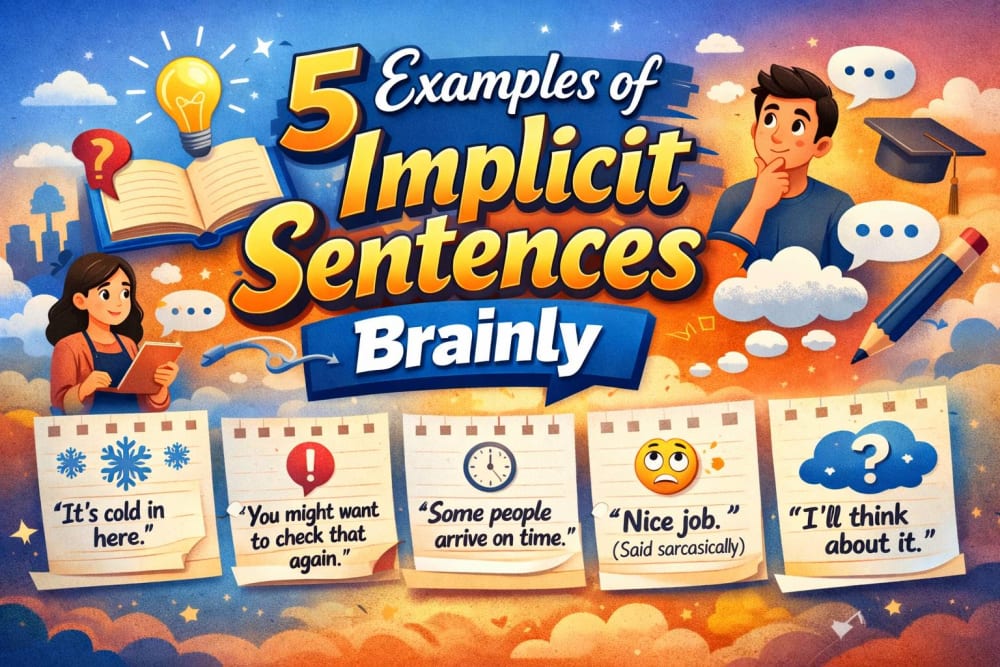
Students often search for 5 Examples of Implicit Sentences Brainly when they need quick, understandable answers for assignments or exams. The goal is not just to find examples, but to understand how meaning can exist beyond the literal words in a sentence. This concept appears in language studies, comprehension exercises, and even real-life communication.
Implicit sentences are important because they reflect how people naturally speak and write. Instead of stating everything directly, speakers rely on tone, context, and shared understanding. Learning how to recognize this helps improve reading comprehension, writing clarity, and communication skills across academic and everyday situations.
What are implicit sentences and why do students search for them?
Implicit sentences are statements where the intended meaning is not directly stated but understood through context. In simple terms, the sentence says one thing but suggests another. Students look for these examples because they often appear in exams, especially in reading comprehension and grammar exercises.
Many learners struggle because implicit meaning requires interpretation, not just memorization. Unlike direct statements, these sentences depend on tone, situation, or cultural understanding. That is why students turn to platforms like Brainly for quick clarification and ready-to-use examples.
In academic settings, implicit sentences test critical thinking. Teachers expect students to read between the lines and explain hidden meanings. This is especially common in literature and English language papers, where deeper understanding matters more than surface-level reading.
Understanding implicit meaning also prepares students for real conversations. In daily life, people rarely say everything directly. Recognizing implied intent helps avoid confusion and improves communication accuracy.
What are five clear examples of implicit sentences?
Implicit sentences are best understood through simple, real-life examples. Each example carries a hidden meaning that the listener is expected to understand without it being explicitly stated.
Consider the sentence, “It’s getting late.” The direct statement refers to time, but the implied meaning is often a suggestion to leave or end an activity. Another example is, “You might want to double-check that,” which implies that something is incorrect without directly saying so.
A third example is, “Some people actually prepare before exams.” This subtly criticizes someone for not studying. Similarly, “That was interesting” can imply dissatisfaction depending on tone. Lastly, “I’ll think about it” often signals hesitation or indirect refusal rather than genuine consideration.
These examples show how meaning changes based on context. The words themselves remain simple, but the intention behind them carries the real message.
How do implicit sentences work in everyday communication?
Implicit sentences function by relying on shared understanding between the speaker and the listener. Instead of being direct, the speaker assumes the listener can interpret the underlying message. This makes communication smoother and sometimes more polite.
In many cultures, indirect communication is preferred to avoid sounding rude or confrontational. For example, instead of saying “You are wrong,” someone might say, “Are you sure about that?” The meaning remains clear without being harsh.
Tone of voice, facial expressions, and situation all play a role in interpreting implicit meaning. The same sentence can have different meanings depending on how it is delivered. This is why context is essential when analyzing such sentences.
In professional environments, implicit communication is also common. Managers may use indirect language to give feedback, and understanding this helps avoid misunderstandings and improves workplace communication.
What mistakes do learners make with implicit meaning?
One common mistake is taking every sentence at face value. Learners often focus only on the literal meaning and miss the intended message. This leads to incorrect answers in exams and confusion in real conversations.
Another issue is ignoring context. Without considering the situation or tone, it becomes difficult to interpret what the speaker truly means. For example, sarcasm can completely change the meaning of a sentence, but it is often overlooked by beginners.
Students also tend to memorize examples without understanding the concept. This approach works temporarily but fails when new or unfamiliar sentences appear. Implicit meaning cannot be learned through memorization alone.
Lastly, overthinking can create problems. Not every sentence has a hidden meaning, and trying to find one everywhere can lead to incorrect interpretations. Balance is important when analyzing language.
How can you identify and write better implicit sentences?
To identify implicit sentences, start by asking what the speaker really wants to convey. Look beyond the words and consider the situation, tone, and relationship between the people involved. This approach helps uncover the intended meaning more accurately.
Reading widely can improve this skill. Exposure to dialogues in books, articles, and real conversations builds familiarity with indirect language. Over time, recognizing implicit meaning becomes more natural.
When writing implicit sentences, focus on subtlety. Instead of stating everything directly, allow the reader to infer part of the message. For example, rather than saying “You are late,” you might write, “We started a while ago.”
Practice is essential. Try rewriting direct sentences into indirect ones and compare the impact. This helps develop both understanding and application of implicit communication in different contexts.
Conclusion
Implicit sentences play a key role in both academic learning and everyday communication. They teach students how to interpret meaning beyond words and respond more thoughtfully in different situations. While many learners initially struggle with this concept, consistent practice and attention to context make it easier to understand.
Focusing on real examples, avoiding common mistakes, and applying the concept in daily communication can significantly improve comprehension skills. Over time, recognizing implicit meaning becomes less of a challenge and more of a natural part of understanding language.
FAQs
1. What are 5 Examples of Implicit Sentences Brainly?
Implicit sentences convey meaning without directly stating it. Examples include “It’s cold in here” or “I’ll think about it.” Students use Brainly to find clear examples quickly.
2. How do implicit sentences differ from explicit sentences
Explicit sentences state the meaning clearly, while implicit sentences rely on context or tone. Understanding the difference improves reading comprehension and writing.
3. Why are implicit sentences important in communication?
They allow subtlety, politeness, and indirect feedback in conversations. Implicit sentences make communication smoother and more natural.
4. What are common mistakes learners make with implicit sentences?
Students often take sentences literally, ignore context, or over-interpret hidden meanings. These mistakes can lead to misunderstandings.
5. How can I practice identifying implicit sentences?
Reading books, analyzing dialogues, and rewriting direct sentences indirectly improves skills. Practice helps you understand implied meaning more accurately.
Enjoyed this article? Share it with others!